


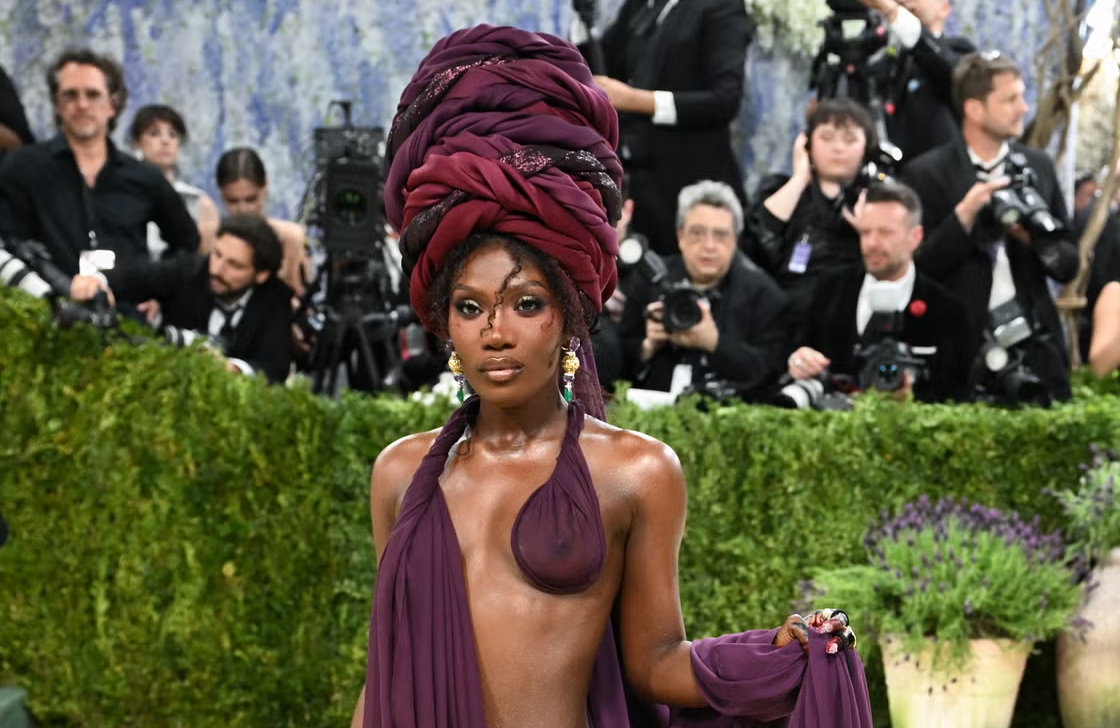
At the Met Gala 2026, where interpretation matters as much as execution, Doechii delivered one of the evening’s most conceptually cohesive looks—an ensemble that didn’t just follow the theme “Costume Art,” but actively interrogated it.
Fabric as Architecture
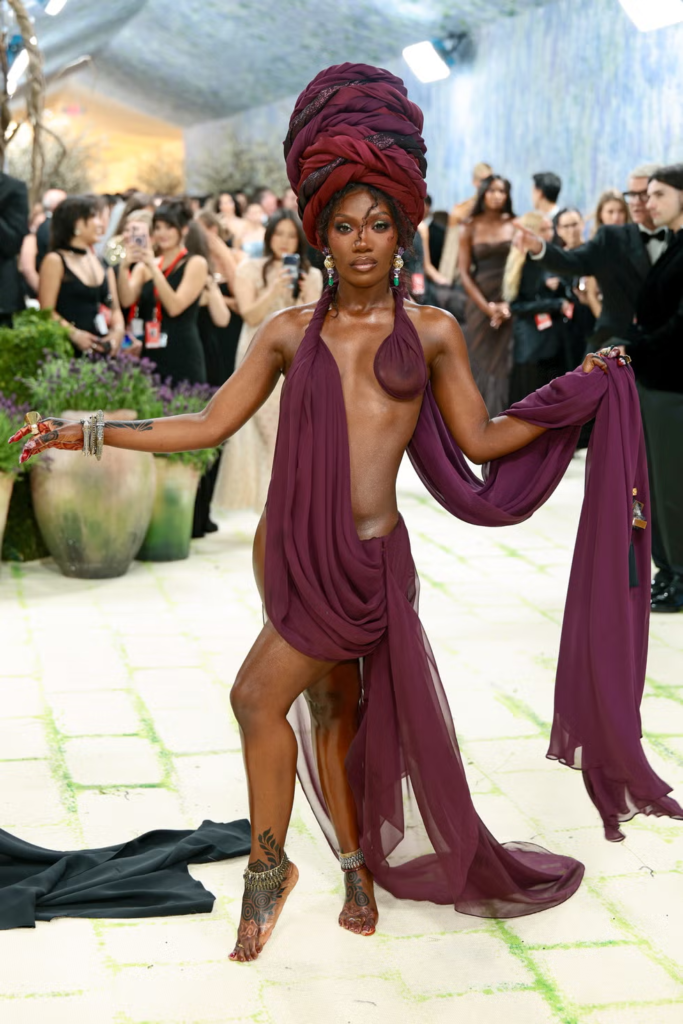
Rather than relying on traditional couture techniques like rigid corsetry or heavy embellishment, Doechii’s custom Marc Jacobs look explored construction through tension and draping. Wine-colored strips of fabric wrapped, twisted, and spiraled around her body, forming both garment and gesture.
The silhouette avoided conventional symmetry. Instead, it embraced asymmetry as a structural principle—an approach that made the outfit feel alive, almost in motion. The bodice extended and reconfigured itself into a scarf-like extension, blurring the line between clothing and accessory.
This wasn’t just styling—it was spatial design.
The Headpiece as Focal Thesis
The defining element of the look was the towering headpiece, composed of the same twisted fabric language. It didn’t function as mere adornment; it acted as a vertical extension of the body, exaggerating scale and redirecting attention upward.
In doing so, the headpiece reframed proportion. The human figure became elongated, almost sculptural, echoing the night’s broader exploration of the “dressed body” as both subject and medium.
Negative Space and Exposure
Strategic exposure played a critical role. The garment’s sparse coverage wasn’t incidental—it was engineered. By allowing sections of skin to emerge between the fabric’s winding paths, the design created a dialogue between absence and presence.
This interplay made the body integral to the composition, not secondary to it. The look only fully existed in motion, as fabric shifted and skin appeared and disappeared within the structure.
Evolution from Debut
Compared to her debut at the Met Gala the previous year—where she embraced tailored precision—this appearance marked a decisive pivot. The earlier look leaned into controlled, menswear-inspired lines. This time, she opted for fluidity, abstraction, and conceptual risk.
It’s a progression that signals intent: not just to participate in fashion’s biggest night, but to use it as a platform for experimentation.
Why It Worked
What made this look resonate wasn’t its scale or boldness alone—it was its internal logic. Every element, from the fabric choice to the headpiece’s construction, adhered to a consistent visual language.
In a space where spectacle can easily tip into excess without meaning, Doechii’s appearance stood out for its clarity of concept. It was fashion operating as theory—precise, deliberate, and open to interpretation.
And that’s exactly what the night demanded.
